We have fixed an issue where when saving the SFTP credentials, the SFTP folder value was not prepended with a /.
Changelog
Every update to the Pipe platform: new features, improvements and fixes.
Improved Uploads For Large Files
New ImprovementWe’ve implemented multipart upload for Amazon S3 object storage and compatible services (Google Cloud, Digital Ocean Spaces). This applies to both the Pipe storage and to your own storage for recordings larger than 100 MiB in size.
What this means for you:
- This method ensures improved throughput, which means that you will experience faster uploads for large files, especially visible if the upload happens between different geographical regions, for example, if the recording is uploaded from our EU2 region towards your S3 object storage located in the US or Asia. From our limited testing, we’ve observed as much as a 3x increase in upload speeds.
- Another benefit is that you will be able to upload recordings that are larger than 5 GiB in size.
- On choppy connections, parts that failed to upload will be retried (up to 3 times) instead of retrying the entire file.
We have updated the Recordings page:
- Implemented the option for the users to filter their recordings by the UTC date.
- The Copy and conversion delay is now present for each recording
- The switching pages of recordings now works properly.
On the Dropbox Integration page the user is now able to see which email is connected for each recording environment.
If the user disconnects the Dropbox App, he will see the remaining time it will take for the changes to reflect to our servers, or can manually remove the credentials by pressing a button.
Clearer Transcoding UI
ImprovementWe have made a better user experience by making it clearer and notifying the user with an alert that at least one video output should be selected on Transcoding Engine page.
The users can now remove themselves completely from our News & Product Updates list rather than subscribing and unsubscribing.
We now save the client provided User Agent when a password reset is made and we display it in the account dashboard under https://dashboard.addpipe.com/sessions to let you see from what kind of browser/device the password reset was initiated.
Updated Signing Webhooks Docs
ImprovementWe’ve updated the Singing Webhooks docs with:
- new info regarding what data needs to be signed (and how to get it) when using
application/jsoninstead ofapplication/x-www-form-urlencoded - updated PHP code
- “Signing” instead of “Authenticating”
le: added a new Python & Flask code example
We’ve just released our new integration with Dropbox.
This simplifies the whole process and streamlines the authorization using the industry standard oAuth flow.
If you are using Dropbox to store your Pipe recordings, we encourage you to switch to the new integration.
le: the new integration is covered in this new blog post.
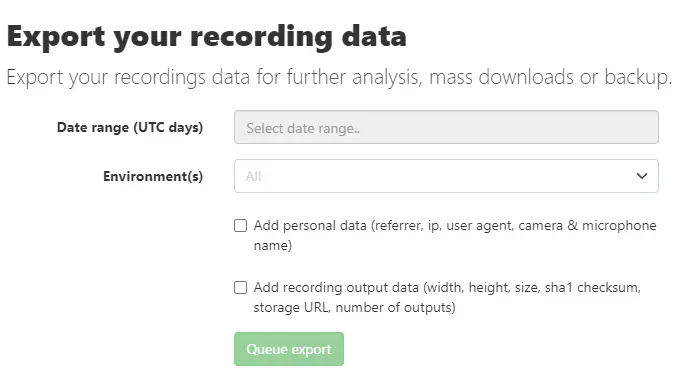
We have just launched a feature that allows you to export your recording data.
You can access this new feature by going to: https://dashboard.addpipe.com/export
On this page you will be able to set a date range for the export, select the environments you wish to export data for, and choose whether or not to export additional datasets(personal data, recording output data) alongside the default dataset.

Some example use cases for the exported recording data:
- importing the data into other tools for analyzing
- downloading all the recordings that are stored by Pipe
- review of the PII we process alongside the recordings
- backup
LE: More details on this new feature can be found in the blogpost.
We’ve now limited access to our EU1 only region option to those environments that already have it selected.
Fixed an issue where, when there was a queue of recordings that needed to be processed - because of large volumes of incoming recordings - recordings uploaded through our native mobile recording client would be processed after the recordings streamed or uploaded through the desktop recording client.
Historically, recordings streamed or uploaded through our desktop recording client had higher priority.
This also paves the way for a better use of priorities.
Clarified that the “information about the devices used to sign up, sign in and request a password reset” is kept for 3 years (not 1) after the account is deleted.
The info and retention period are shown at https://dashboard.addpipe.com/sessions.
Booted StatusCake uptime and SSL monitors for most of our infrastructure. We’ll probably stop using Pingdom soon.
Chunked upload for SFTP
Improvement FixUntil recently, recordings that were larger than 1GB failed to upload through SFTP.
With this update, we’ve implemented chunked upload through SFTP for the transcoded .mp4 file and original raw recording, removing any size limit.
The fix comes in two parts:
- Large files are read in smaller chunks
- Those smaller chunks are streamed with a higher upload speed towards your server through SFTP
The Pipe “account area” hosted at https://addpipe.com has now been moved to https://dashboard.addpipe.com and renamed to “account dashboard”.
- 3 years for sign up. sign in, reset pass event data
- Unsubscription from the News & Product Updates e-mail list is separate
- Data needed for usage/pricing calculation
Granular Copy Is Better
ImprovementThe copy in the Pipe account area has been updated:
- More granularity around whether or not you’re in the News & Product Updates e-mail list:
- NOT IN IT
- IN IT AND SUBSCRIBED
- IN IT AND UNSUBSCRIBED
- Clarity around the status of cancelled but not expired subscriptions
We’ve now successfully migrated most of our CentOS 8 machines to Rocky Linux.
CentOS 8 has reached End Of Life (EOL) on December 31st, 2021.
New Google oAuth flow is live
ImprovementThe Sign In With Google functionality just got a complete makeover. More details in a future blog post.
le: blog post is live https://blog.addpipe.com/a-proper-sign-in-with-google-implementation/ .
A 5x increase in recording limits
New ImprovementWe’ve substantially increased some of the recording limits.
All of the following received a 5x increase.
Daily recordings
All account types now have higher daily recordings limits:
- Trial accounts daily recordings limit has been increased from 100 to 500
- Standard accounts daily recordings limit has been increased from 250 to 1250
- Pro accounts daily recordings limit has been increased from 500 to 2500
Upload size
Whether you’re trying to:
- upload existing recordings through our desktop recorder
- upload recordings through the mobile native recording client
- POST them directly to our private POST API
we have increased the size limit for the files from the previous 1GiB to 5GiB
Default maximum recording time
The default value for the maximum recording time in the account embed dashboard has been increased from 2 minutes to 10 minutes.
Finally managed to pinpoint the cause of the issue.
The culprit for the resulting low audio was the audio constraint echoCancellation when set to false. Setting it to true solved the issue.
Here is a quick overview of what audio constraints were being set and what is being set now:
| constraint | before fix | now (after Android fix) |
|---|---|---|
echoCancellation | forced to false in pipe.js | not set, relying on browser default value which for now is true |
autoGainControl | set to false by Chrome/Firefox (inherited value from echoCancellation) | not set, relying on browser default value which for now is true |
noiseSuppression | controlled by the developer through the ns in the embed code, defaults to true | unchanged |
So to sum it up, we’ve decided to remove echoCancellation altogether and rely on the browser defaults which is echoCancellation set as true for Chrome, Safari, and Firefox.
Cap on macOS version under /recordings
ImprovementSince Safari, Chrome and Firefox browsers now cap the macOS version in their user agents to 10.15, the /recordings section under the Pipe account area will now report “Mac OS X 10.15 or later” for macOS Catalina, Big Sur, Monterey and future versions.
To take full advantage of our two existing US regions, we’ve implemented a fallback mechanism at the recorder level, that springs into action if one of the US regions is down.
This new mechanism, available on the embed code 2.0, applies to both the recordings made with the HTML5 recorder via streaming and to uploads from desktop and the mobile native recorder, but each works a little differently.
Fallback for streaming
The HTML5 streaming recorder will automatically fallback to the other US recording server if the initial connection to the assigned US recording server fails to connect in a timeframe of 10 seconds. Once a successful connection is established, the recorder will stick to that connection. If any other disconnects occur, the reconnect attempts will be made to the same US server.
Fallback for uploads
When it comes to uploads from desktop or the mobile native recorder, the recorder will have 3 attempts to connect to the assigned US recording server and if all of them fail, it will automatically fallback to the other US recording server and retry the upload. Again, once a successful connection is established, the recorder will stick to that connection.
We’ve heard your requests and we’ve listened.
Thanks to the new embed code setting, avrec, now you can show or hide the option to record video/audio just like you can show/hide the other options displayed in the initial screen of the recorder.
If the avrec setting is not specified in the embed code or is set to 1, the record video/audio option will be displayed. To hide it, simply set it to 0.
With this newly added setting together with the setting srec and dup, you can now separately show or hide all 3 options in the initial screen of the recorder: record video/audio, screen recording, and upload video/audio.
Additionally to this, we’ve added a new dropdown in the embed dashboard section that allows you to directly choose what type of recorder you wish to embed.

Of course, having any combination of the 3 options is still possible by manually editing your embed code.